
Part of our Business guides
Explore more articles on marketing, pricing, and growth in our Business section.
At some point, every photographer asks the same question: can I turn this into a real business? If you’re reading this, you’re probably at that point right now.
I’ve been running my own photography company since 2016, building two separate 6-figure businesses in Singapore and Thailand. Over the years, I’ve learned what actually drives results and how to turn photography into a sustainable, profitable business.
The truth is that running a photography business is 80% business and 20% photography. That’s where most photographers get stuck.
In this article, I’ll walk you through the path from your first paid job to a 6-figure photography business, focusing on what to prioritise at each stage and what actually moves the needle.
Stage 1 ($0 – $10,000): Getting Your First Paid Work
At the beginning, your only goal is to get your first few paid jobs. You’re not optimising for pricing, branding, or systems yet. You’re simply trying to validate that there is demand for your work and start building momentum.
To do that, you need to start simple and get your service in front of real clients as quickly as possible.
Offer a Minimum Viable Service
The fastest way to do that is to offer a minimum viable service. Instead of overthinking your brand, website, or pricing, focus on the simplest version of your service that someone would actually pay for. Photography is simpler than most businesses in this regard. You don’t need to build a product, you just need to package your service and start offering it.
For portrait photographers, mini sessions are one way to offer a simpler, more affordable service.
This is where you learn the most. You’ll quickly find out who is willing to hire you, what they actually need, and how sensitive they are to price. When I first started, I tried targeting birthday event planners and found that they were extremely price sensitive. Since my pricing didn’t match their expectations, I created a simpler, lower-cost package just for that segment.
That’s the value of starting early, it helps you test your assumptions before you invest too much time or effort.
Price to Get Your First Clients
At this stage, pricing isn’t about maximising income. You just want to get your first few clients and understand what the market is willing to pay. You may need to price lower than what you eventually want to charge, but the priority is getting real jobs, building your portfolio, and learning how clients make decisions. You can always raise your prices later, but you can’t improve a business that hasn’t started.
Build a Portfolio That Gets You Hired
At the same time, you need to build a portfolio that reflects the kind of work you want to be hired for. Clients don’t care about qualifications or gear, they care about whether you can produce the images they need.
If you don’t have paid work yet, create personal projects that showcase your style and direction. If you’re exploring multiple niches, keep your work clearly separated so clients can immediately see relevant examples without confusion.
Don’t Get Stuck on Gear

It’s easy to think you need better equipment before you can start, but in 8 years, I’ve only had 2 or 3 clients ask what gear I use. They’re hiring you for your work, not your camera. As long as your equipment isn’t limiting your results, it’s good enough.
Instead of thinking about gear, think about the work you want to create. Outside of paid work, use personal projects to explore your style and build a body of work that reflects the kind of jobs you want to be hired for.
It’s also worth being intentional about what you learn from. Watching endless gear reviews doesn’t improve your photography. Spend that time understanding the art and history of photography instead. Instead of scrolling through Instagram, look at the work of photographers who have shaped the craft. Photo books are a much better resource for understanding visual style, sequencing, and storytelling.
Focus on getting real work, building your portfolio, and developing your eye. That’s what moves you forward at this stage.
Stage 2 ($10,000 – $100,000): Becoming Consistent
Getting your first few jobs is one thing. Turning that into consistent bookings is where your business actually starts to take shape. At this stage, your focus shifts from taking any job you can get to building a steady flow of work from the right type of clients.
Choose a Niche That Fits You
Photography isn’t a one-size-fits-all profession. Different niches require different skills, working styles, and even personalities.
Event photographers need to work quickly in unpredictable environments and capture fleeting moments, while portrait photographers need to be socially engaging and guide their subjects. Product photographers, on the other hand, spend more time solving technical lighting and styling problems.
There are also lifestyle considerations. If you shoot events or weddings, you’ll likely be working nights and weekends, which can either suit your lifestyle or become a long-term constraint.
At this stage, it’s important to focus on one or two niches at most. Spreading yourself too thin makes it harder to build a reputation and get repeat work.
Do Market Research Before You Commit
Once you’ve chosen a niche, you need to understand the market around it. Look at the size of the market, the number of photographers in it, and the prices clients are paying.
A crowded market isn’t necessarily a bad thing. In many cases, it’s a sign of strong demand. For example, conferences, corporate events, and brand activations continue to grow, especially in major cities. These events need consistent, reliable photography, which creates ongoing opportunities for event photographers.
On the other hand, small or declining markets can be difficult to break into. For example, photojournalism has become much harder to sustain as a career, as budgets have shrunk and many publications rely on a small pool of established photographers. Unless you’re already connected in that industry, it can be very difficult to get consistent work.
Some markets also have gatekeepers. Commercial or advertising work often go through agencies, and without the right connections or portfolio, it can be hard to even get considered.
Doing a bit of research early can save you a lot of time and frustration later.
Identify Your Ideal Clients
Once you understand your niche, you need to be clear about who you’re trying to work with. These are your ideal clients, the people most likely to hire you repeatedly, pay sustainable rates, and need the kind of work you enjoy doing.
For example, if you’re an event photographer, your clients could include event planners, venues, or organisations that run their own events. Many of these clients have recurring needs, such as companies that host regular conferences, internal events, or marketing activations throughout the year.
Some will handle smaller private events, while others work on larger corporate productions, but the key is that the same clients often come back for multiple projects. Building relationships with them can lead to a steady stream of repeat bookings instead of constantly finding new clients.
It’s important to understand where your opportunities come from. If there are very few potential clients in your area, that’s a sign you may need to adjust your niche or expand your scope.
Define Your Pricing Position
At this stage, pricing becomes more structured. Instead of adjusting your rates for every job, you want to understand where you sit within your local market and start quoting more consistently.
Most markets naturally fall into tiers. There are lower-priced photographers competing on affordability, a mid-range where most professionals operate, and a higher-end segment driven by brand and reputation. As you gain more experience, you’ll start to see where you fit.
If you’re still early, it’s normal to start closer to the lower end to build experience. Over time, many photographers move towards the mid-range, where you can balance volume, quality, and sustainable income.
At the same time, keep your pricing simple. Complicated packages and constantly changing rates make it harder for clients to decide and slower for you to quote. A consistent hourly or half-day rate is often enough at this stage, with adjustments only when the scope changes significantly.
Find a Repeatable Source of Clients

Part of becoming consistent is to stop relying on one-off jobs and start building a repeatable source of clients.
Getting your first few bookings often comes from opportunistic channels like friends, referrals, or one-time gigs. That’s useful early on, but it’s not something you can rely on long term. If every job comes from a different place, you’re starting from zero each month.
What you want instead is a channel that consistently brings in enquiries.
This could be:
- referrals from past clients
- partnerships with venues or event planners
- social media
- paid ads
- or SEO
For me, SEO became one of my main acquisition channels. I started investing in it early on and treated it as a long-term system rather than a quick experiment. Over time, it compounded, and today it generates around 60% of my new enquiries and contributes six figures in revenue each year.
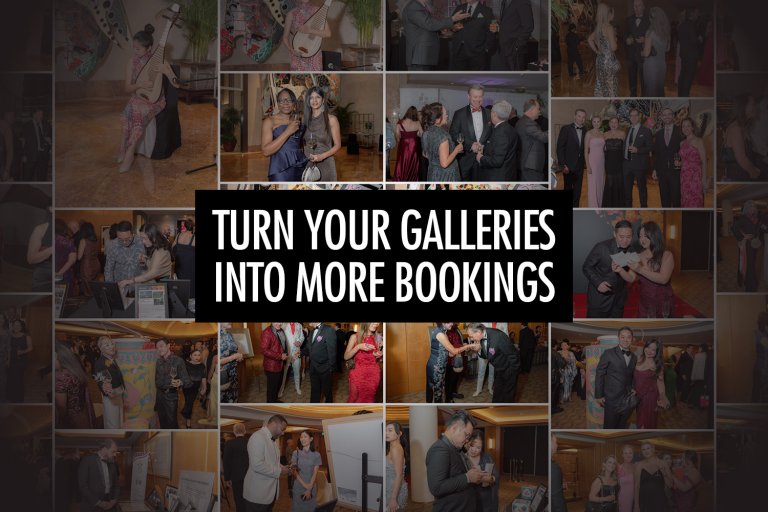
Another approach I’ve found effective is turning every event into a source of new leads by sharing my photos more actively with guests.
That said, there isn’t a single “best” channel. SEO worked for me because it matched my skill set and how I preferred to work. Other photographers do much better with social media, referrals, or paid ads.
What matters is not the channel itself, but whether it is repeatable.
A repeatable channel has two key characteristics. First, it consistently brings in enquiries without you having to start from scratch each time. Second, you understand how it works well enough to improve it over time.
Once you find one channel that works, focus on it and double down. You don’t need multiple channels at this stage. One reliable source of clients is enough to make your income consistent and give you a foundation to build on.
Improve Your Conversion and Follow-Up
Getting enquiries is part of the equation. The other part is how consistently you convert them into clients.
One of the biggest factors here is speed of response.
From my experience, I close many deals simply because I was the quickest to respond. Clients often reach out to multiple photographers, and the first one who replies clearly and professionally has a strong advantage.
The second factor is following up.
In my case, around 30% to 40% of my bookings come from follow-ups. Many leads are interested but get busy or forget to reply. A simple follow-up brings the conversation back and gives them a chance to move forward.
Stage 3 ($100,000+): Scaling Your Business
Once you’re consistently booked, the next challenge is scaling.
Your time is now the main constraint. There are only so many hours you can shoot, which means your income will plateau unless something changes. To grow further, you need to increase your revenue per event and build systems that allow you to handle more work without doing everything yourself.
Increase Revenue Per Event
The biggest shift for me came when I stopped thinking about photography as just coverage and started thinking about how it contributes to the overall event experience.
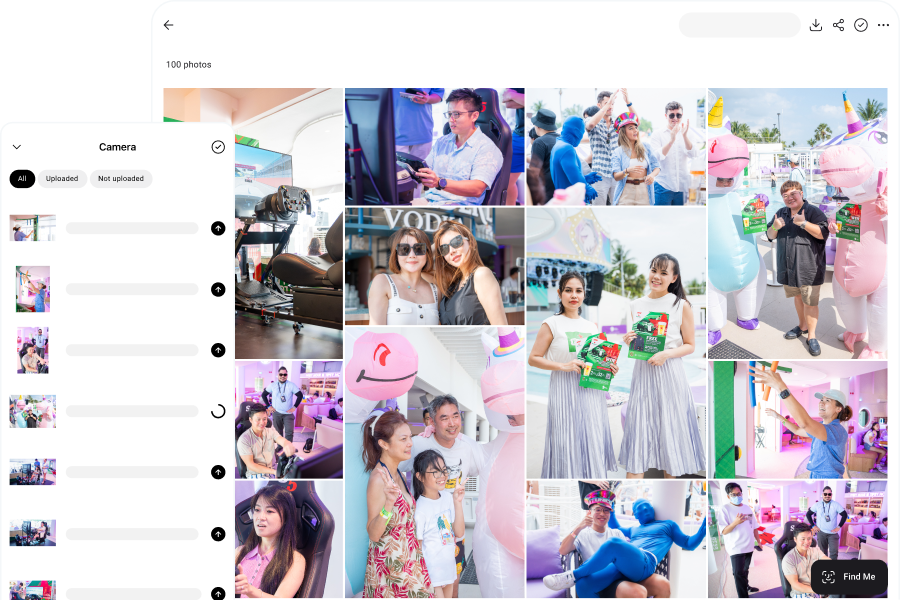
For events, most of the value comes from what happens during the experience, not after. When guests can see their photos immediately, easily find their own photos, or see images displayed live on screens, photography becomes part of the event itself.
I started packaging services like instant photo sharing with face recognition, live slideshows, and live printing into my offerings. These didn’t require me to shoot longer hours, but they changed how clients and guests experienced the photography. I use Honcho to handle the workflow so everything runs in real time during the event.
For the same coverage, I could charge around 2.5 times more by bundling these services into a higher-tier package. If you want a more detailed breakdown of how to structure and price these packages, I’ve written a complete guide to event photography pricing.
Instead of selling time, I was selling a more complete experience that aligned with what event organisers actually care about, which is engagement.
Build Multiple Sources of Clients
Once I had one reliable source of enquiries, the next step was to expand beyond it.
For a long time, SEO was my main acquisition channel. It worked well, but relying on a single channel comes with risk. If something changes, your pipeline can slow down.
Over time, I added Google Ads and cold outreach to event organisers. These gave me more control over demand and allowed me to generate enquiries more consistently. Together, these channels contributed another 30% of my revenue.
At the same time, all of these channels are amplified by referrals and repeat clients. As you deliver more work, you naturally build relationships with clients who come back for future events or recommend you to others.
In my case, repeat clients now make up around 40% of my bookings. That has a huge impact on stability, because I’m no longer relying entirely on new leads every month.
Scale Your Production and Delivery

At some point, you’ll have more demand than you can handle on your own. You can either turn down work or find a way to scale your capacity. To do that, you need to start thinking in systems and how to hand off parts of the work without a drop in quality.
For me, that meant hiring other photographers. I know many photographers are against this, but the alternative is saying no to opportunities. I chose to work with a small group of 2 to 3 photographers whom I trust, and I’ve personally trained and invested time in getting them aligned with how I shoot. That allowed me to take on more work without compromising the quality of what I deliver.
The second bottleneck is editing, especially during busy periods. When you’re shooting frequently, post-production can pile up, and delivery timelines start to slip. For me, delivering photos on time is non-negotiable. Letting busy seasons drag out delivery is poor service, and it affects how clients perceive your reliability.
To solve this, I outsource my editing. This allows me to maintain consistent turnaround times even during peak periods. Alternatively, you can use AI editing tools to speed up your workflow.
Strengthen Your Differentiation
As you grow, one of the most important things is having a clear reason why clients choose you over someone else. If you don’t define that clearly, you end up competing on price.
For me, that differentiation came from the experience I provided. I focused on making photography a visible and engaging part of the event through instant sharing, live slideshows, and on-site printing.
Not all differentiation looks the same.
For portrait photographers, your ability to make someone feel comfortable and confident in front of the camera can matter more than technical skill. Commercial photographers often stand out through a distinct look that clients recognise and want to associate with their brand.
It can also come from how you operate. Being reliable, delivering on time, and making the process easy for clients sounds basic, but it’s where many photographers fall short. The key is to be known for something specific. Not everything, not “high quality,” but something clients can immediately associate with you.
Conclusion
To build a 6-figure photography business, you need to focus on the right things at each stage.
At the beginning, the goal is simply to get your first few clients and prove there is demand for your work. Then it’s about becoming consistent, finding your niche, your clients, and a repeatable source of enquiries. Finally, it’s about scaling, increasing your revenue per event, building systems, and growing beyond your own time.
Most photographers get stuck because they try to optimise too early or focus on the wrong problems. They worry about branding before getting clients, or pricing before understanding their market.
If you focus on the constraint in front of you, the path becomes much clearer.
You don’t need a perfect plan to start. You just need to take the next step, learn from the market, and keep building from there.