
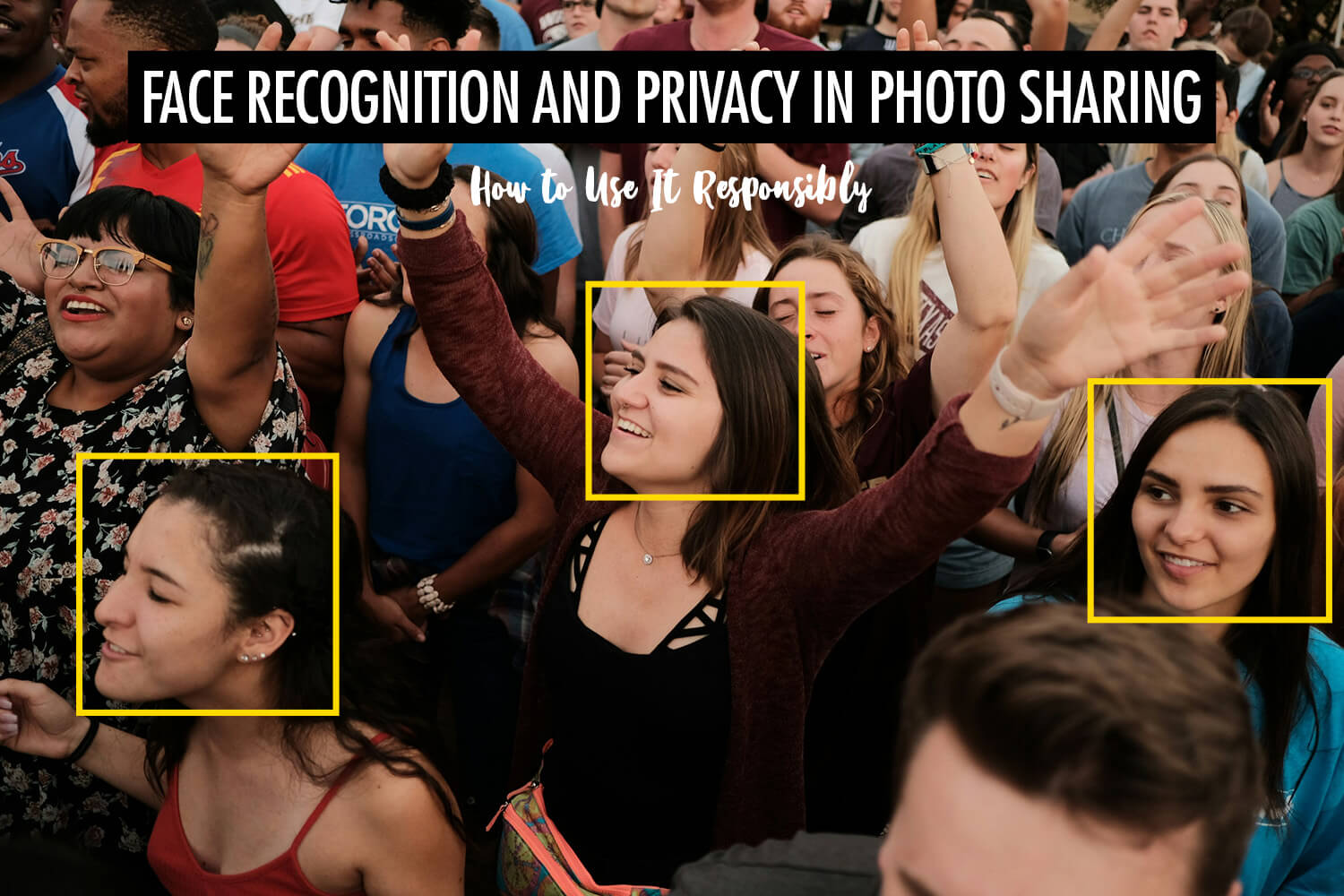
Face recognition can be a sensitive topic, and understandably so. When people hear the term, they often think of surveillance, tracking, or companies building permanent databases of faces.
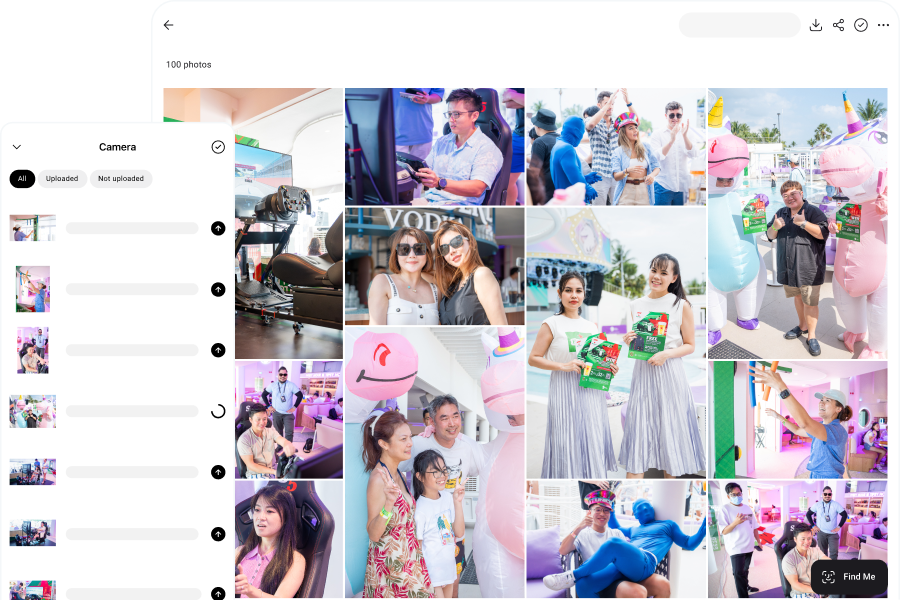
But face recognition for event photo sharing is a different use case. The goal is not to identify strangers in public, but to help guests find their own photos inside a specific gallery. This is especially useful at corporate events, marathons, headshot booths, and other events where hundreds or thousands of photos need to be shared with the right people.
In this article, we’ll look at how face recognition can be used responsibly for AI photo sharing, what happens when a guest uploads a selfie, how facial data is handled, and why privacy depends on how the system is designed.
Photo-Sharing Face Recognition Is Not Surveillance
One common concern is that face recognition feels like surveillance.
That concern makes sense. Surveillance usually means identifying people without their active involvement, often in public or semi-public spaces. The person may not know it’s happening, may not have agreed to it, and may not know how the information is being used.
Face recognition for photo sharing works differently. The goal is not to track people or identify strangers, but to help someone find their own photos inside a specific event gallery.
Here’s a simple way to think about it:
Surveillance asks, “Who is this person?”
Photo-sharing face recognition asks, “Which photos match the person who chose to search?”
The person is not being silently identified. Instead, they’re actively using the system to find photos of themselves.
The Guest Should Be in Control
Face recognition for photo sharing should be opt-in. It shouldn’t happen secretly in the background.
That means the guest must choose to use it. They open the gallery, upload a selfie, and search for their own photos. They should understand what the selfie is being used for and what happens after that.

That user intent is important. The system is not trying to identify every person for the photographer. It’s helping each guest find their own photos after they choose to participate.
The more transparent the process is, the less uncomfortable the technology feels.
How Facial Data Is Handled
People often want to know what happens to their selfie, whether any facial data is stored, and how long that data stays in the system.
To understand that, it helps to know how face recognition works behind the scenes.
Instead of manually comparing face images, each detected face is converted into a mathematical representation called a face vector. This vector captures certain facial features as numbers, so one face can be compared with another. A face vector is not a photo.
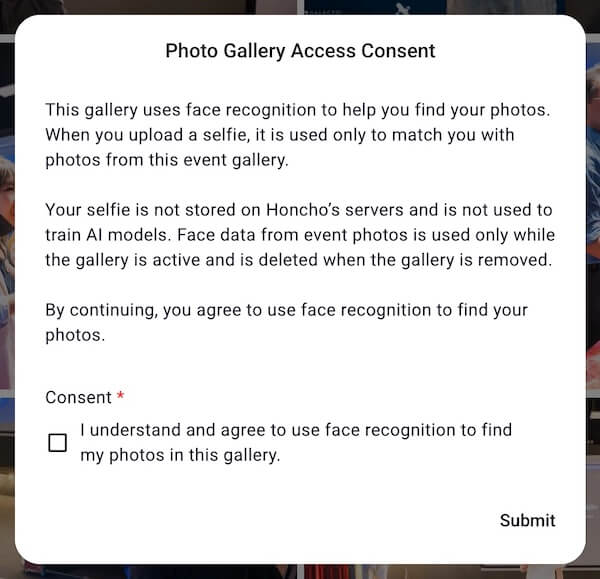
With Honcho’s face recognition feature, the policy is straightforward. When a guest uploads a selfie, it’s used for matching but is not stored on Honcho’s servers. The selfie stays on the user’s device. Honcho’s AI models are also pre-trained, which means selfies and event photos are not used to train or improve the system.
To make searching work while an album is active, Honcho temporarily stores face vectors generated from the event photos. These vectors are anonymized and are not linked to names, contact details, or other personal information. They simply allow the system to compare a guest’s selfie with the faces detected in the gallery.
When the album is removed, the related face vectors are deleted as well. This means the facial data only exists for as long as the event gallery itself is active.
Face Recognition and GDPR
Under GDPR, facial data can be treated as biometric data when it’s used to identify someone. That means it needs to be handled carefully. It does not mean face recognition can never be used, but it does mean photographers and event organizers should be clear about how it works.
For event photo sharing, the main principles are simple. Guests should know face recognition is being used. They should choose whether to use it. They should understand what their selfie is used for. Their facial data should not be used for anything unrelated, and it should not be kept longer than necessary.
Selfies and event photos should also not be used to train AI models. This is Honcho’s policy.
With Honcho, photographers can create forms that guests must complete before entering the gallery. These forms can be used to collect explicit permission or consent, so guests understand what they are agreeing to before they access their photos.
Face Recognition Can Make Galleries More Private
Face recognition is often seen as a privacy risk. But in event photography, the bigger privacy issue is often the traditional gallery experience.
At many events, all photos are uploaded into one gallery and shared with the client, guests, or even the public. Anyone with the link can scroll through everyone’s photos. This can be a problem at public events, school events, corporate functions, or marathons, where guests may not want their photos easily visible to everyone else.
Face recognition gives photographers a more private option. Instead of showing the full gallery by default, photos can be blurred or restricted. Guests then use face recognition to reveal only the photos that match them.
That changes the model from:
Everyone can see everything.
To:
Photos are hidden by default, and each guest only sees their own matches.
Conclusion
Face recognition is not inherently good or bad. It depends on how it’s used.
Used poorly, it can feel invasive. Used responsibly, it can improve the guest experience and make photo sharing more private.
For AI photo sharing, a responsible approach is simple: make it opt-in, explain what the selfie is used for, avoid storing more data than necessary, do not use guest photos to train AI models, and delete facial data when the gallery is removed.
That’s the difference between using face recognition as a surveillance tool and using it as a privacy-conscious way to help people find their own photos.