
If you shoot public events, such as marathons, festivals, roadshows, or large parties, you’ve probably run into this challenge.
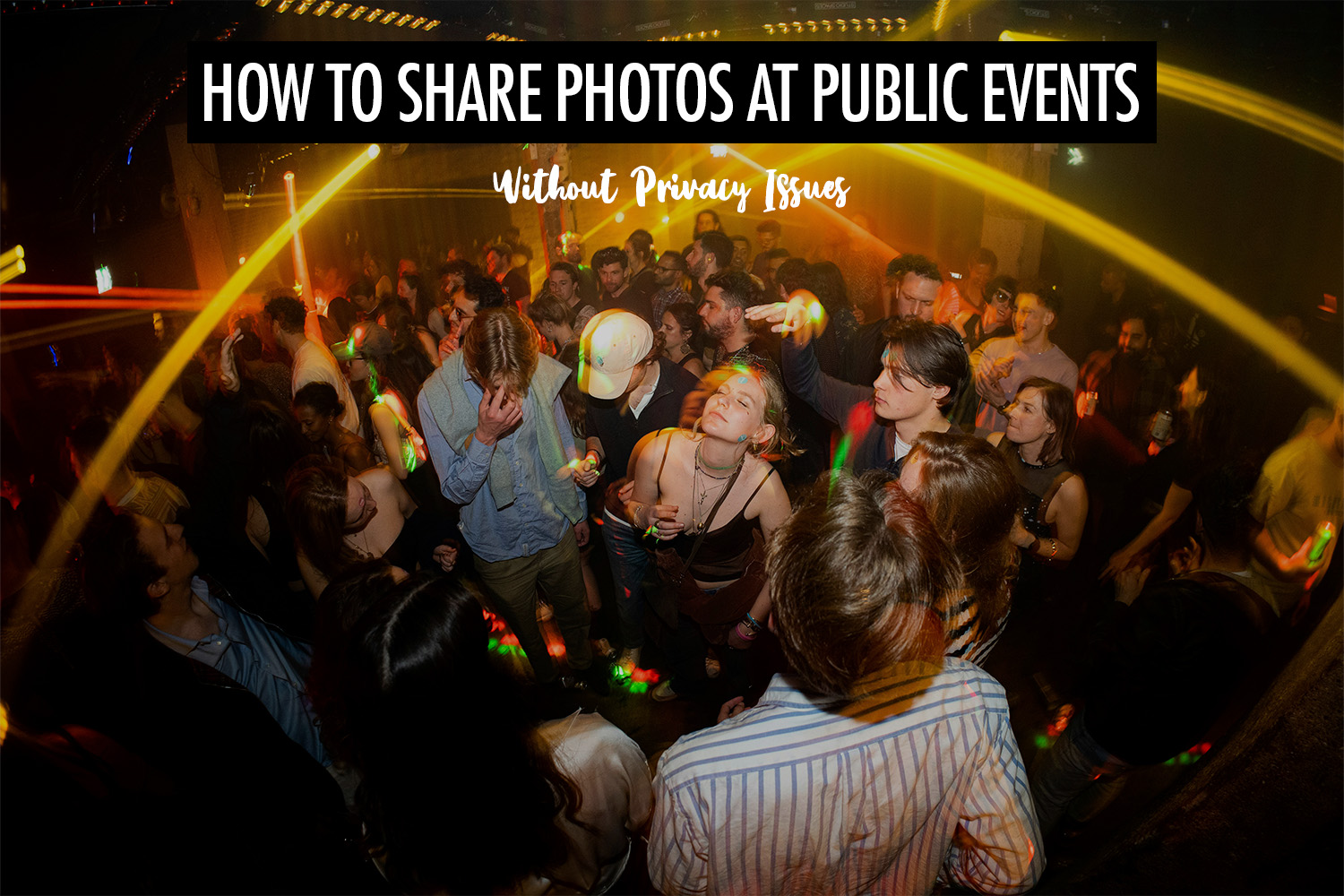
When you deliver the photos, whether through an online gallery or on Facebook or Instagram, anyone with access can scroll through them. Not just the people in the photos, but complete strangers.
Most people aren’t comfortable with that. It’s a real privacy concern.
In this article, I’ll break down the limitations of common sharing methods and a better way to distribute photos widely, without exposing everyone to everyone else.
Common Ways Photographers Share Event Photos
Before looking at better approaches, it helps to understand how photographers typically share event photos today. Most rely on a few common methods, each with its own tradeoffs.
Social Media Platforms
Platforms like Facebook and Instagram are often the fastest way to share photos from an event.
You can upload a selection of images, tag the client or event, and reach a wide audience almost instantly. For smaller or more casual events, this can be enough.
The downside is that once photos are posted, they’re fully public. Anyone can view and share them. For public events, that means people have little control over where their photos end up.
Online Galleries
Another common approach is to upload all the photos to an online gallery and share a single link.
This gives you more control over presentation and quality. You can organise photos and deliver full-resolution images in one place.
But access is still broad. Anyone with the link can view the entire gallery, which means guests end up seeing photos of people they don’t know. At large events, this can mean thousands of images that anyone can scroll through.
Password-Protected Galleries
To add some level of restriction, photographers sometimes password-protect their galleries.
This limits access to people who have the password, which is usually shared with the client or attendees. While this feels more private, passwords are easily passed around, especially at public events. Once someone has access, they can still see every photo in the gallery.
It also doesn’t resolve the underlying tension. You want to share the photos widely, but also protect people’s privacy, and passwords don’t really solve that.
The Real Problem: Privacy vs Distribution
At the core of this issue is a simple tradeoff.
If you restrict access, fewer people will see their photos.
If you open access, everyone can see everything.
That’s the problem with most sharing methods today. They operate at the gallery level, not the individual level. You either give full access to the entire set of photos, or you limit access and reduce how many people actually find theirs.
A Better Approach: Personalised Photo Access
Instead of sharing all photos with everyone, a better approach is to change how access works.
Rather than giving people access to the entire gallery, you give each person access only to their own photos.
This shifts photo sharing from a group experience to a personal one. Guests no longer need to scroll through hundreds or thousands of images to find themselves, and they’re not exposed to photos of people they don’t know.
More importantly, it removes the tradeoff between privacy and distribution. You can share the gallery widely, while still controlling what each person sees.
How Face Recognition Changes Photo Sharing
This is where face recognition comes in.
Instead of giving everyone access to the full gallery, images are matched to individuals.
With platforms like Honcho, photos are uploaded to a gallery as usual, but they’re blurred by default. Guests can access the gallery, but they won’t immediately see all the images.
To view their photos, they upload a selfie. Face recognition scans the gallery and finds the images that match them, instead of requiring the photographer to manually sort photos for each guest. Once matched, only those photos are revealed.
From the guest’s perspective, they only see what’s theirs, and nothing else.
The results depend on how accurate face recognition is in real-world conditions, and modern AI photo sharing apps handle this very well, even across different demographics.
Adding Notifications to Complete the Experience
Finding photos is one part of the experience. Knowing when new ones are available is just as important.
With Honcho, guests can opt in to receive notifications after they’ve uploaded a selfie, via email or WhatsApp.
Once they’ve been matched, they’ll automatically be notified when new photos of them are found. As more photos are uploaded throughout the event, they continue receiving updates without having to check the gallery manually.
This keeps engagement high even after the event. Guests are reminded to come back, view their photos, and share them while the event is still recent.
How This Works at an Event
Here’s how this works at an actual event.
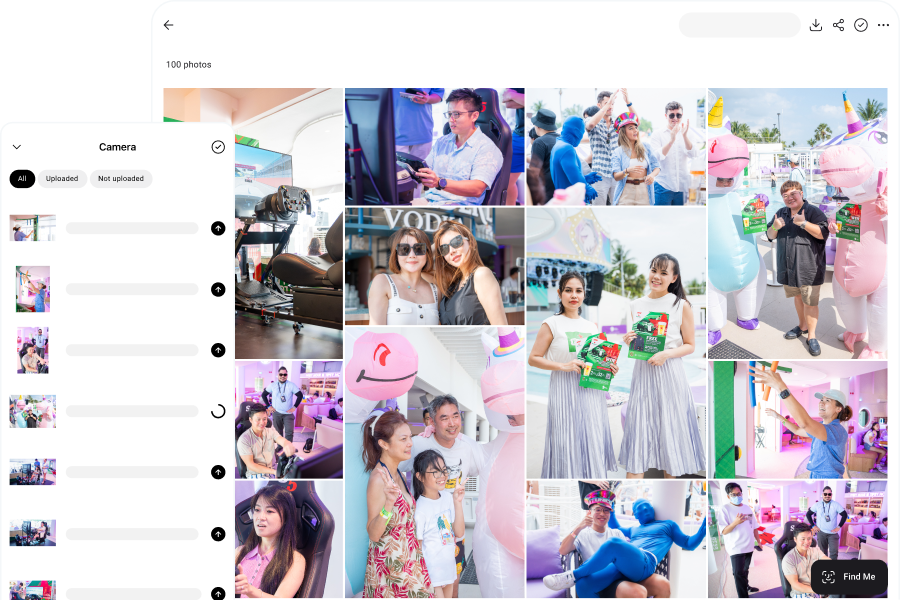
You start by uploading photos to your gallery as you shoot, or shortly after. With Honcho, this can happen in real time, so photos are available while the event is still ongoing.
At the event, you display a QR code that guests can scan. This brings them straight to the gallery on their phone.
From there, they upload a selfie. Face recognition matches them to their photos, and only those images are revealed.
As you continue shooting and uploading, new photos are added to the gallery. Guests will see more of their photos appear over time, and if they’ve opted in, they’ll also receive notifications via email or WhatsApp.
This process scales even for events with hundreds or thousands of people.
For more on what happens to the selfie and how consent can be handled, see our article on face recognition privacy.
Conclusion
This smarter approach solves the core problem by removing the tradeoff between privacy and distribution.
Guests only see their own photos, so privacy is protected. You can share the gallery widely without worrying about exposing everyone to everyone else.
It also makes it much easier for people to find their photos. Instead of scrolling through hundreds or thousands of images, they get exactly what they’re looking for in seconds.
That convenience leads to higher engagement. Guests are more likely to view and share their photos when the experience feels simple and personal.